“Mental Health refers to how we feel, think and act. Positive mental health allows us to enjoy life, manage stress and cope with challenges.”– School Mental Health Ontario (SMHO)
Positive mental health and well-being is our goal for each student at the WRDSB.
Supporting the Needs of All WRDSB Students
Every student is unique, and will experience and express positive mental health in their own way. There is no one right way to experience and express positive mental health. Mental health and well-being are fluid. Everyone experiences challenges and hardships and being equipped to navigate these challenges is essential for experiencing and sustaining positive mental health.
Students are more likely to find and utilize strategies and resources that will support their mental health and well-being when we provide:
- Identity-affirming, culturally responsive environments
- Engaging mental health learning opportunities, and support
We strive to support positive mental health for students through:
- Environment
- Students are supported in feeling a sense of belonging and positive mental health when they feel:
- Welcome
- Included
- Affirmed in their identity
- Understood
- Supported
- Connected
- When staff and students co-create mentally healthy schools and classrooms this supports the well-being of all
- Students are supported in feeling a sense of belonging and positive mental health when they feel:
- Learning
- Growing our understanding of mental health and well-being helps us:
- Develop skills for navigating life’s challenges
- Recognize mental health struggles in ourselves and others
- Know how and where to access help
- Growing our understanding of mental health and well-being helps us:
- Support
- Sometimes students need additional support
- When students need support for their mental health, regulated school mental health professionals provide intervention that is:
- Evidence-informed
- Identity-affirming
- When students need support for their mental health, regulated school mental health professionals provide intervention that is:
- Mental health professionals also connect students to additional community support when beneficial or needed
- Sometimes students need additional support
- Engagement
- By partnering with students, families, staff and community we can:
- Learn and grow together
- Feel heard and supported
- Contribute to the well-being of others
- Achieve better outcomes through dialogue and co-learning
- By partnering with students, families, staff and community we can:
The 2025-2028 Mental Health and Addictions Strategic Plan is about:
- Staying the course
- Meeting the moment
Staying the Course
Many foundational components of the WRDSB’s previous plan continue to be relevant, meaningful, and central to the work. We continue to:
- Centre each student, and recognize that every student will experience a sense of belonging and positive mental health in their own way
- Recognize that in order to experience success in school and in life, students benefit from opportunities to take risks, learn from mistakes, and discover what they are capable of, in the context of a supportive environment
- See staff, parents and caregivers, and community organizations as key partners in our work to support the mental health and well-being of students
- Understand identity-affirmation, and culturally responsive learning and support, as foundational to positive mental health. Everything is filtered through these lenses
- Organize our work through the tiered model of support
Tiered Model of Support
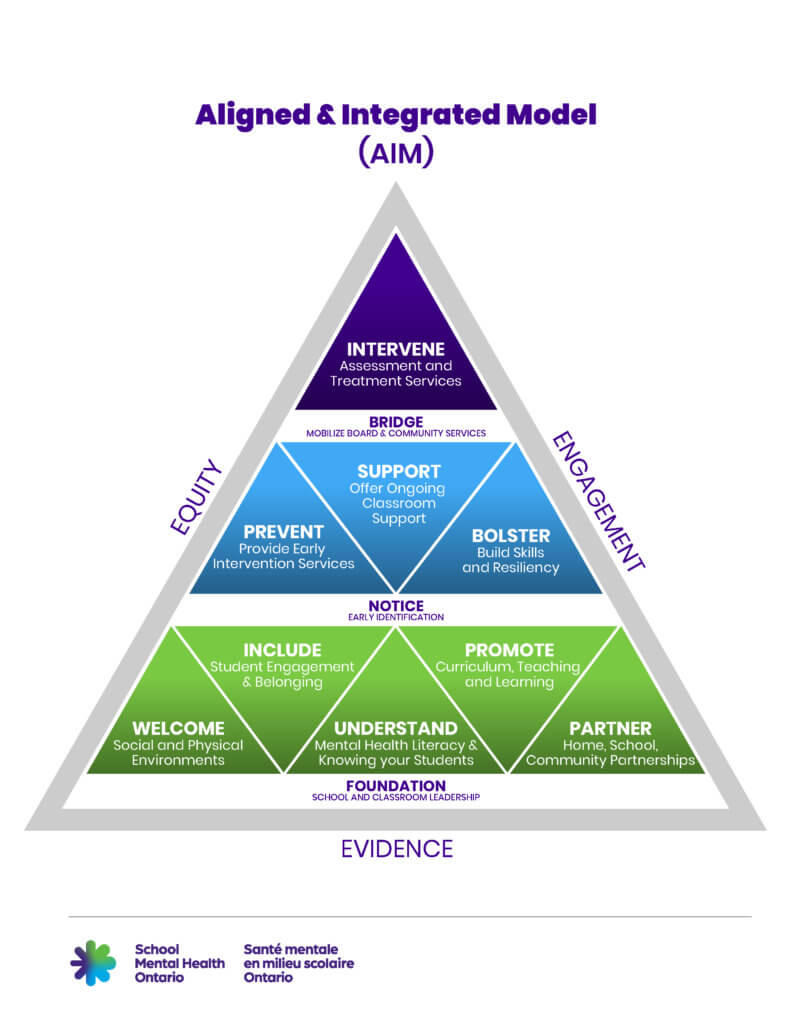
Tier One
Tier One is foundational, and good for all. This includes the co-creation of mentally health schools and classrooms, supportive relationships, a sense of belonging, curriculum-embedded mental health literacy and social emotional learning, and partnerships with families and community organizations to support the well-being of all students.
Tier Two
Tier Two is necessary for some. Some students need additional support. This is where we might notice concerns and reinforce skills. At the tier 2 level we can also bring in additional support in the form of targeted prevention, early intervention, and evidence-informed interventions from school mental health professionals.
Tier Three
Tier Three is essential services for a few. A smaller number of students will require more intensive support beyond what is available in schools. At this level school mental health professionals help students and families access appropriate community or health services and manage crisis events as they arise.
Meeting the Moment
Following the wisdom and experience of our students, families, staff and community, we are:
- Adapting and reorganizing some components of the previous strategy
- Focusing on the current themes and concerns raised by these important stakeholders
Families
We are amplifying families as essential partners in promoting positive mental health and well-being for students. Just as each student will experience and express positive mental health and well-being in their own way, families are also unique. In this plan we commit to authentic and meaningful engagement with families in order to partner together to support the well-being of students.
Honouring Lived Experience
We commit to honouring the lived-experiences of students and families alongside evidence-informed practices and tailoring resources and support to be identity-affirming, and culturally responsive.
Engagement
The areas of focus for student, staff, and family/caregiver learning are being guided by the feedback received from these groups during the consultation process for the creation of this plan.
Students
When taken together, the top areas identified for student learning across all audiences (students, parents and caregivers and staff) were:
- Managing stress and worry
- Healthy habits to promote mental health and well-being
- Healthy relationships
- Social media
Parents
Parents and caregivers identified the following areas as their top areas of interest for their own learning:
- How to support your child when they are struggling with their mental health and well-being
- Early clues that your child might be struggling with their mental health and well-being
- Promoting positive mental health and well-being at home
- These were the top three areas for parents and caregivers of students of all ages/grades
Staff
Student-facing employees were also asked about their learning interests and Professional Development will be planned in a responsive manner, by role, based on their feedback.
The top overall areas of interest, across staff groups include:
- Promoting student mental health and well-being in my role
- Creating mentally healthy schools and classrooms
- Supportive conversations with students in distress
- Tools and resources available to help support student mental health and well-being